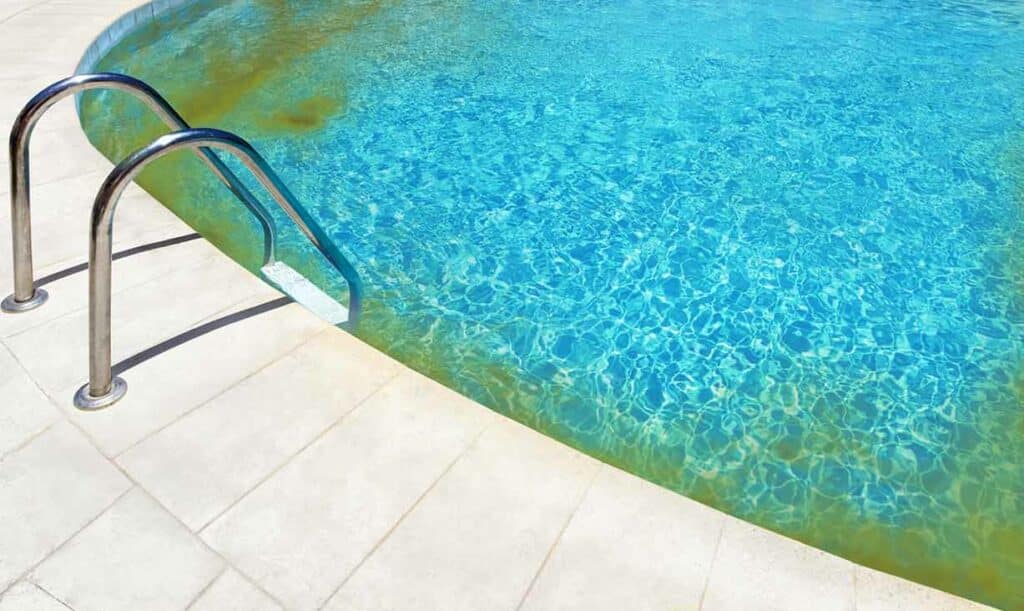
“My pool is green.” What do I do now? If you find yourself in this situation, don’t worry, it’s common and easy to fix.
In fact, in this article you will learn in a simple way how to remove green water from the pool.
The usual cause of green water in the pool is the presence of algae, which are produced by a combination of factors such as excess phosphates, lack of chlorine, unbalanced pH, lack of maintenance, dirt in the water, high water temperature or lack of filtration, among others.
Algae reproduction starts from 11º-12º of temperature. The higher the water temperature, the higher its reproductive capacity.
To prevent the appearance of green algae and not having to remove green water from the pool, act before the hottest weeks of the summer and do not winterize your pool until the water is below 18°C (64°F).
Phosphates are the preferred food of algae. If you want to avoid the proliferation of algae in your pool, it is essential to control their presence and eliminate them.
Although they are very necessary in gardening, as they help to have healthy plants. However, in pool maintenance, the presence of phosphates often leads to the proliferation of resistant algae that will be difficult to eliminate.

Phosphates can get into pool water through rain, wind, swimmers, nearby vegetation, lawn fertilizer, use of well water or recycling plants.
Here is more information on everything you need to know about phosphates in the pool.
Chlorine is very ineffective at pH above 7.4. In addition, high pH (above 7.4) is the ideal environment for algae growth, which will cause you to have to remove green water from the pool.
Now that you know why pool water turns green, let’s delve into the solutions. But, first, let’s take a look at the correct phosphate, alkalinity and pH levels so that you can avoid finding yourself in this situation again.
To know if your pool has phosphates you have several methods, from analytical strips for pool water analysis to photometry equipment such as the Scuba 3s digital analyzer, which measures 11 parameters (including phosphates).
It is important to note that there will always be a certain amount of phosphates in the water, but the maximum safe level is 125 ppb. Above that level, algae will find their perfect environment to grow and reproduce.
By reducing phosphates, you will reduce the possibility of having to remove green water from the pool and, above all, of algae reappearing periodically, forcing you to do shock chlorination cycles every few years.

Before balancing the pH always remember to balance the alkalinity, because if the alkalinity is low, the pH of your pool will be very unstable and the chlorine will act irregularly.
A correct alkalinity (between 80-150) will allow maintaining a solid and stable pH. If the alkalinity is low, you will need to add pool chemicals such as an alkalinity booster according to the manufacturer’s dosage. If the alkalinity, on the other hand, is too high, you should reduce it by using liquid pH reducer.
Once the proper alkalinity level has been reached, we will adjust the pH. Under normal conditions, the pH level should be between 7.2 and 7.4 to ensure safe water for bathers and to ensure the effectiveness of the chlorine at the same time.
Here is a guide with more information about alkalinity and pH in swimming pools.
Follow these steps and we assure you that your pool will become transparent sooner than you think.
When phosphate levels exceed the maximum limit, the way to reduce them is to always use a phosphate remover before any shock treatment involving algae.
To remove phosphates, start by washing and rinsing the pool filter and then apply phosphate remover at the manufacturer’s recommended dosages. Let the pump filter the water for 24 hours so that the product is distributed throughout the pool.
Removing phosphates will kill algae food, but you will still need to remove green water from the pool. To do this, we must continue with the next step: pH balance and shock chlorination.
For shock chlorination to eliminate algae, we will look for a pH level lower than normal, around 6.8. This exceptionally low pH will allow the chlorine to work more effectively, helping to eliminate and oxidize algae and bacteria faster.
To increase or decrease the pH level, products such as pH reducer or pH increaser can be used.
Once the phosphates have been removed and the alkalinity and pH are at proper levels, perform a wash and rinse to the filter to ensure that it is in good condition to aid the algae removal process.
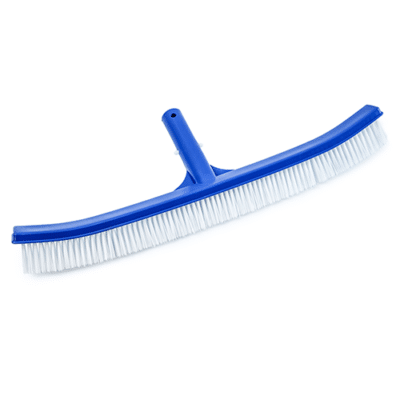
If there is visible algae on the pool walls, it is recommended to brush intensively just before adding chlorine around the perimeter.
Immediately afterwards, a shock chlorination will be carried out following the doses recommended by the manufacturer.
It is advisable to use fast-acting chlorinated green pool water removal products, such as liquid, powder or granulated pool chlorine. It is important to remember to always dissolve the product in a bucket with plenty of water and distribute the solution around the perimeter of the pool. Here we explain which chlorine is best for the pool.
Also, remember that if your pool is made of liner or reinforced pvc liner, you will have to be careful not to discolor it. Perform hyperchlorination always dissolved in bucket and respecting the conditions established by the manufacturer of liner or reinforced pvc liner.
Once the walls have been brushed and shock chlorination has been performed on the water, the pool filtration should be run for 24 hours with the valve in the “Filtration” position.
If the steps up to this point have been followed correctly, it is likely that the pool water will begin to clear in 2 to 3 hours.
After 24 hours of shock chlorination, it is necessary to wash and rinse the pool filter to remove all residues that have been retained during the process.
After this, it is time to re-balance the pool water to achieve suitable levels for swimming, such as:
The presence of algae and green water in the pool is a common problem that can be prevented and treated by following a number of key steps.
It is important to regularly monitor pH, alkalinity and free chlorine levels, as well as remove phosphates, to prevent algae from growing and developing in the pool water.
By periodically controlling these parameters and maintaining a proper maintenance routine, we can enjoy a clean and algae-free pool all summer long. If you have any doubts or problems with “stubborn algae”, do not hesitate to contact us, we will be happy to help you.

PoolComet choice
 Select options
This product has multiple variants. The options may be chosen on the product page
Select options
This product has multiple variants. The options may be chosen on the product page
Discover everything you need to know to install a pool, spa or jacuzzi on your terrace, attic or rooftop safely and efficiently.
Do you want to extend the bathing season? Explore the world of swimming pool heat pumps. Find out how this efficient air-conditioning solution works, its advantages and what factors to consider when choosing the perfect model that will allow you to enjoy warm water all year round.

Discover the deepest pool in the world. With 60 meters deep and a breathtaking underwater environment that emulates a ruined city, it is a paradise for diving enthusiasts and a once in a lifetime experience.
Seleccionar categoria