One of the main objectives of every pool owner is to keep the water clear. One of the most effective ways to achieve this is through cartridge filtration.
As we will see below, it is not the most popular option in Europe, but it has so many advantages that you should consider it as part of your home (or community) pool equipment.
In this article, we will provide you with a complete guide on cartridge pool filters, including their advantages and how to use them.
What is a cartridge filter?
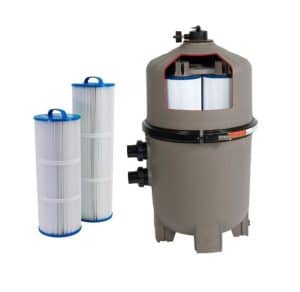
A cartridge filter is a device used to filter pool water and trap dirt.
The filter contains one or more cartridges made of high-strength synthetic fibers. These cartridges are pleated and wrapped around a plastic core. Unlike sand, which traps particles down to 20 microns, the cartridge filter traps dirt and particles down to 10 microns in size, significantly improving water clarity.
Although it is not the most common filtration media in Europe, in the USA, the world’s largest swimming pool market, cartridge filtration is the most popular, thanks to its filtering properties and benefits in terms of pool maintenance.
Let’s see why.
What are the advantages of a cartridge pool filter?
Better filtration: Cartridge pool filters are very effective at removing dirt and sediment from the water. They are capable of trapping particles down to 10 microns, which means your pool water will be much cleaner than with a traditional sand or glass filter.
Easier water treatment: clear water is much easier to maintain chemically. Chlorine and other disinfectants, as well as non-chlorine treatments such as ultraviolet systemsor copper-silver copper-silver ionizationare much more effective in pools with non-turbid water.
Less chemical consumption: a clear water requires less chemical action. The better the filtration, the less water problems your pool will have and the less chemicals you will have to add.
Water savings: Sand filters require backwashing to clean retained dirt. Thousands of liters of water are wasted during this process. Cartridge filters are cleaned with a simple hose, so there is no need to waste so much water.
More filtering surface in less space: A sand filter has a filtering surface that is limited by the diameter of the filter and by the filter bed. On the other hand, a cartridge filter can offer the same filtering surface in less space. Example: a 600mm diameter sand filter (one of the most common) has a filtering surface of 0.28m2 and about 40 cm of filtering bed height. The equivalent cartridge filter provides 4.6m2 (about 5 times more surface area), and also with a higher filtration fineness.
Energy savings: by not having to renew water so frequently, the pool water is better treated and the energy required to heat the pool is less than with other systems.
Easy maintenance: The maintenance of a cartridge pool filter is very simple. You just need to remove the filter cartridge and wash it with a garden hose. If the cartridge is very dirty, you can use a specialized cleaning solution for filter cartridges.
How to use a cartridge filter for swimming pools?
Cleaning: Cleaning the filter cartridge is important to maintain filter efficiency. The cartridge should be cleaned every two weeks to prevent dirt build-up. To clean the cartridge, simply remove it from the filter and wash it with a garden hose. If the cartridge is very dirty, you can use a specialized cleaning solution for filter cartridges, such as Aquafinesse’s Filter Cleaner from Aquafinesse or the sand cleaner always in diluted form.
Replacement: The filter cartridge should be replaced approximately every two years. If the cartridge is damaged or very dirty, you will need to replace it sooner. Be sure to purchase a replacement cartridge that is compatible with the filter model you have in your pool.
How to choose the right cartridge filter for your pool
To choose the right cartridge filter for your pool, you should consider several factors:
Pool size and number of bathers: The size of the pool will determine the size of the filter you need. As a general rule, a residential pool should be recirculated every 4 hours. Both the pump and the cartridge filter should be sized for that mission and work with similar filtration flow rates. If your pool is very crowded, we recommend sizing the filter and pump with higher flow rate equipment.
Type of pool: If you have a large, public pool (hotel, rural tourism, sports center), you will need a larger cartridge filter. If you have a smaller pool, a smaller cartridge filter will be sufficient. There are options to filter Condominium Pools with this type of filter, if you have doubts about which one should be yours, contact us without obligation.
Type of debris: If your pool receives a lot of debris, such as leaves and twigs, you will need a cartridge filter with a higher filtration capacity. If your pool does not receive a lot of debris, a smaller cartridge filter will be sufficient.
In conclusion, we would say that cartridge filters are an excellent alternative to sand filters. With easy installation, low maintenance, lower water consumption and higher particle retention efficiency, cartridge filters are an investment worth considering.
Discover the definitive guide to Hayward Automatic cleaning robots. Explore their most reliable models for cleaning and maintaining your pool, from powerful to compact options. We help you choose the ideal Hayward robot according to the size and type of your pool, ensuring effortless, flawless water.
Discover how to deep clean your removable pool. Learn how to keep the bottom, liner, waterline and filters clean, in addition to balancing the water. This expert guide provides you with the key steps and products for effective maintenance and prolonging the life of your installation.
To provide the best experiences, we use technologies such as cookies to store and/or access device information. Consent to these technologies will allow us to process data such as browsing behavior or unique identifiers on this site. Not accepting or withdrawing consent may negatively affect certain features and functions.
Functional
Always active
The storage or technical access is strictly necessary for the legitimate purpose of enabling the use of a specific service explicitly requested by the subscriber or user, or for the sole purpose of carrying out the transmission of a communication over an electronic communications network.
Preferences
The storage or technical access is necessary for the legitimate purpose of storing preferences not requested by the subscriber or user.
Statistics
The storage or technical access that is used exclusively for statistical purposes.The storage or technical access that is used exclusively for anonymous statistical purposes. Without a requirement, voluntary compliance by your Internet service provider, or additional records from a third party, the information stored or retrieved solely for this purpose cannot be used to identify you.
Marketing
The storage or technical access is necessary to create user profiles to send advertising or to track the user on a website or across multiple websites for similar marketing purposes.

 Select options
This product has multiple variants. The options may be chosen on the product page
Select options
This product has multiple variants. The options may be chosen on the product page