



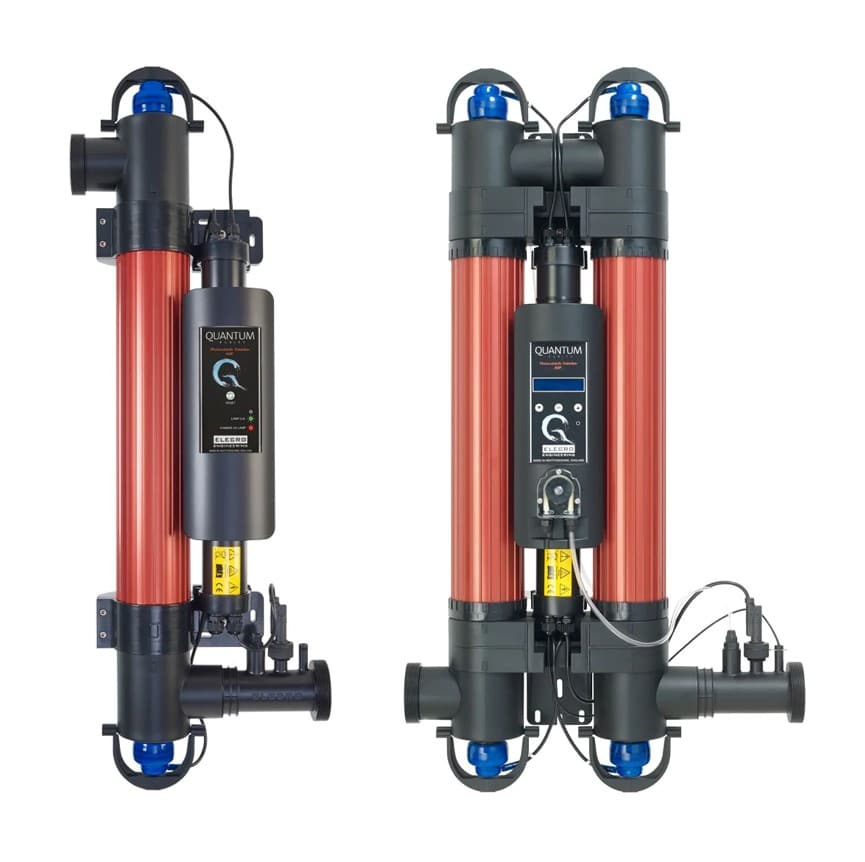


UV Idegis Vega LP in polyethylene for private pools
The UV Vega LP in polyethylene is an ultraviolet treatment system designed to improve pool water quality through high efficiency UV disinfection. Its reactor made of PE polyethylene makes it a resistant and suitable option for private pool installations that seek to reduce the microbiological load of the water and improve bathing comfort.
UV technology acts on the pool water by means of ultraviolet radiation, helping to eliminate microorganisms such as algae, bacteria, viruses, fungi and yeasts. It also helps to reduce combined chlorine, improving water sensation and reducing odors and irritations associated with chloramines.
Advantages of the UV Vega LP
- UV equipment for water treatment in private pools.
- It reduces the need for disinfectants (chlorine, bromine, active oxygen) by up to 85%.
- Reactor made of PE polyethylene.
- Low pressure UV lamp HO.
- UVC dose of 30 mJ/cm² and 254 nm wavelength, capable of destroying highly chlorine-resistant microorganisms such as Cryptosporidium and Giardia.
- Estimated lamp lifespan estimation of up to 13,000 hours, depending on conditions of use and number of ignitions.
- Electronic counter of working hours and ignitions.
- Lamp on indicator.
- Input for external flow detector (not included), which allows the UV system to be switched off when there is no filtration running, extending the life of the lamp.
- Operation at 230 Vac, 50-60 Hz.
- Vertical design for installation in a technical room.
Available models Vega LP in polyethylene
| Model | Recommended flow rate | Rated power / UV-C | Material | pH / ORP control |
|---|---|---|---|---|
| Vega 10 | 10 m³/h | 48 W / 13 W UV-C | Polyethylene PE | Not integrated |
| Vega 14 | 14 m³/h | 56 W / 18 W UV-C | Polyethylene PE | Not integrated |
| Vega 20 | 20 m³/h | 75 W / 25 W UV-C | Polyethylene PE | Not integrated |
| Vega 25 | 25 m³/h | 90 W / 30 W UV-C | Polyethylene PE | Not integrated |
UV treatment to reduce the use of chemicals
Ultraviolet treatment does not completely replace the need to maintain an adequate level of residual disinfectant in the water, but it helps to improve the sanitary quality of the pool and allows for more efficient chemical management. The system should operate in conjunction with pool recirculation, i.e., when the pump and filter are operational.
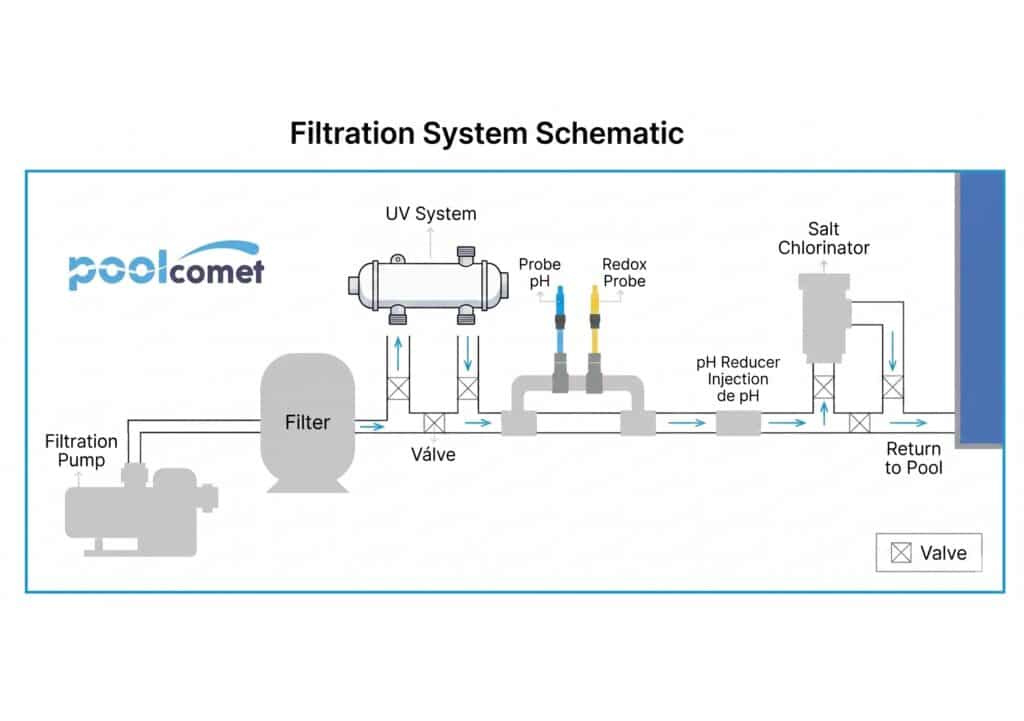
For proper performance, it is recommended to keep the water balanced, with pH and alkalinity within the proper ranges, as well as to install the equipment after the filtration system and before other treatment or dosing devices.
Recommended installation
The UV Vega LP should always be installed in a vertical position, preferably in bypass to facilitate maintenance and to be able to isolate the equipment by means of valves. The water inlet must be at the bottom of the reactor to ensure that the UV lamp remains properly submerged during operation.
The equipment must be placed in a dry, ventilated and weather-protected technical room. It should not be installed in areas exposed to flooding or in corrosive environments, especially near pH reducing products formulated with hydrochloric acid.
It is recommended to choose the size depending on the size of the Filtration pump. In general it would be this recommendation:
| Model | Recommended flow rate | Swimming Pool Filtration Pump – Power |
|---|---|---|
| Vega 10 | 10 m³/h | 3/4HP |
| Vega 14 | 14 m³/h | 1CV |
| Vega 20 | 20 m³/h | 1.5HP |
| Vega 25 | 25 m³/h | 2CV |
Version with optional integrated pH and ORP
This model is the UV Vega LP in polyethylene without integrated pH/ORP control. For installations looking for more complete automation, there is another version of the Vega range with integrated pH and ORP control, designed to automatically manage pH correction and disinfection by means of liquid chlorine or other compatible dosing systems.
The version with integrated pH and ORP allows more advanced automation of water treatment, combining the disinfecting action of UV with pH and redox potential control to regulate chemical dosing.
Maintenance
The main maintenance consists of periodically checking the condition of the UV lamp and the quartz sheath. It is recommended to check the quartz sheath at least once a year for deposits of lime, iron, manganese or organic matter, as these residues can reduce the transmission of UV radiation.
Whenever the lamp is replaced, it is necessary to reset the partial counter of working hours and ignitions of the equipment. The lamp should be handled with gloves to prevent grease or impurities on the hands from affecting its performance and life.








Reviews
There are no reviews yet.