




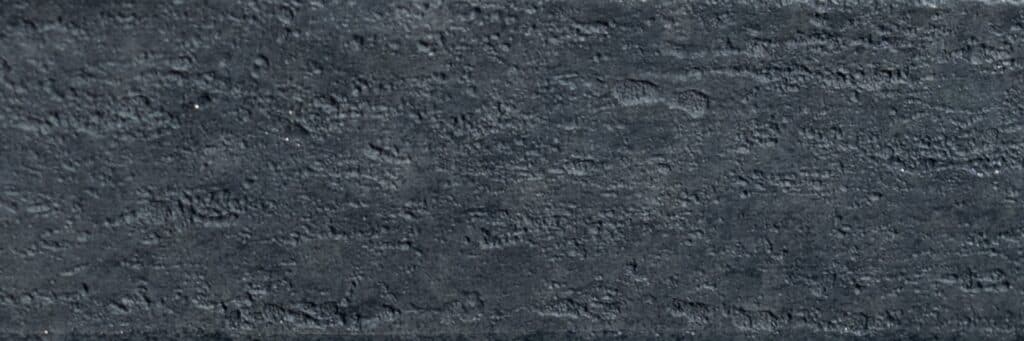



Hydrantis-S EPS (expanded polystyrene) blocks are ideal for the construction of swimming pools using the lost formwork method, offering an efficient, lightweight and durable solution. Thanks to their dual density design (25 kg/m³ on the outside and 80 kg/m³ on the inside), these blocks combine structural strength and thermal insulation capacity.
EPS is one of the materials with the best thermal insulation, allowing to keep the water temperature, in a natural way and without electricity costs, up to 4º compared to systems such as steel, concrete or fiberglass panel pools.
In addition, the EPS block system has an inner face with a resistance of 80kg/m2 …. much higher than any other EPS block used in swimming pools (normally around 15kg/m2-20kg/m2).
In addition, thanks to its lightness and ease of cutting, the Power-S block improves the installation and construction time of the pool by up to 3 days, as it does not require plastering or vertical laying.
It also has the advantage of having an innovative EPS part to make the overflow gutter in “Munich type” pools with a cell housing.
If you want to build your pool with this innovative system, with the best EPS block on the market, do not hesitate and consult us without obligation.
Technical Characteristics – Hydrantis-S EPS block for swimming pools
- Material: High density expanded polystyrene (EPS).
- Density:
- Exterior: 25 kg/m³ for optimum thermal insulation.
- Interior: 80 kg/m³ for maximum mechanical strength and durability on the inside face of the pool.
- Block dimensions: 25cm deep, 30 centimeters high and 1000cm long.
- Concrete load: 135 liters per m2 of formwork.
- Thermal insulation: Excellent, reducing water heat loss.
- Water resistance: 100% water-repellent material, does not absorb moisture or deteriorate over time. It does not rust like steel panels or certain concretes. It does not have osmosis problems, as is the case with fiber pools.
- Resistance to vibrations: EPS is a material that behaves in a very stable way with respect to vibrations, which can be an element to take into account in swimming pools in attics and roofs, where the movement of the water itself can be an element of noise towards the adjacent houses.
- Sustainability: Manufactured with recyclable materials and low environmental impact.
Thermal comparison between EPS, concrete, steel panels and fiberglass.
Are EPS panels really a thermally efficient solution? Undoubtedly, there are technical studies of all kinds that endorse EPS as a material with excellent thermal insulation properties. This allows the heat loss of water to be lower than with other components such as concrete, ceramics, steel or fiberglass.
Thermal Insulation Comparison Chart
| Material | Thermal Conductivity (W/m-K) | Usual thickness for swimming pools | Heat Loss (Relative) | Key Properties |
|---|---|---|---|---|
| EPS (Polystyrene) | 0,030-0,040 | 25-30 cm | Very low | Excellent thermal insulation and completely water-repellent, it repels humidity. |
| Concrete | 1,4-1,7 | 15-30 cm | Highs | It needs additional coatings to improve insulation. May have structural fractures |
| Fiberglass | 0,04-0,05 | 5-10 mm | Low | Good thermal insulator, but may deteriorate over time. May develop osmosis as it is not 100% waterproof. |
| Magnelis® steel | 50 | 3-5 mm | Very high | Requires additional insulation, highly conductive, which causes it to lose |
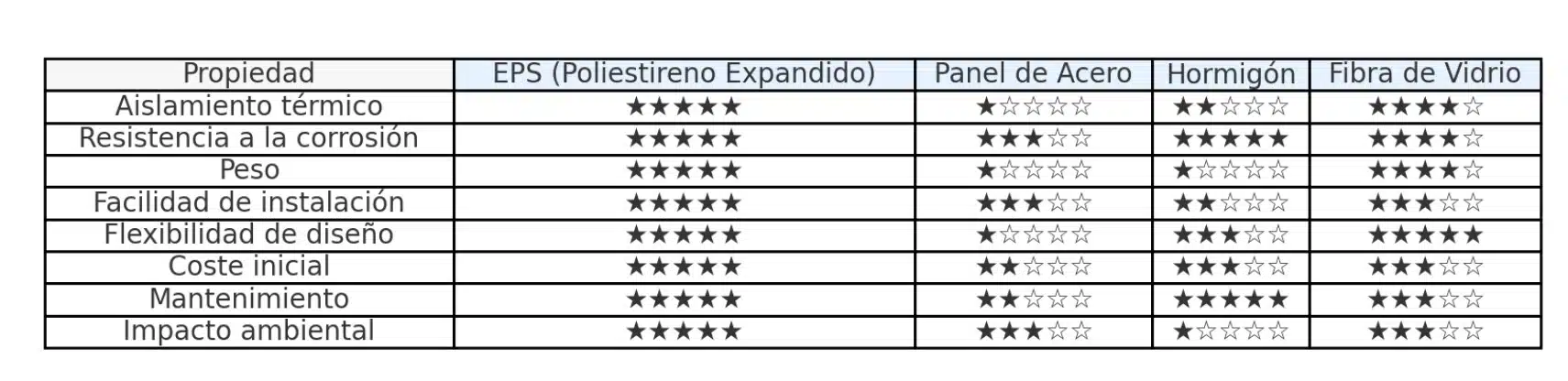
Comparison of construction materials for swimming pools








Reviews
There are no reviews yet.