The operation of a Salt Chlorinator is based on a simple principle: Salt Electrolysis. From the salt dissolved in the water, the equipment is able to generate chlorine automatically, keeping the pool always disinfected without the need to constantly add chemicals.
It is a product that has become one of the most demanded options for pool water treatment. The reason is that, compared to other traditional methods, it offers a more economical, comfortable, safe, skin-, eye- and environment-friendly experience.
A Salt Chlorinator is a device that is part of the Pool filtration system. Its mission is to transform common salt, previously dissolved in water, into chlorine through a process of electrolysis.
The difference with traditional chlorine is clear: instead of adding tablets or liquids manually, the chlorinator continuously generates the necessary disinfectant to keep the water in perfect condition. This translates into cleaner water, with fewer chemicals and much more pleasant for bathers.
The operation of a Salt Chlorinator is simple and automatic. Once the salt is dissolved in the pool water, the chlorinator passes it through the blades located in the cell of the equipment. Electrolysis takes place there: the salt (sodium chloride) is transformed into free chlorine, which acts as a natural disinfectant.

This salt chlorination process is cyclic. The chlorine, once it has fulfilled its function, is converted back to salt, which allows constant production to be maintained without the need to add additional chemicals.
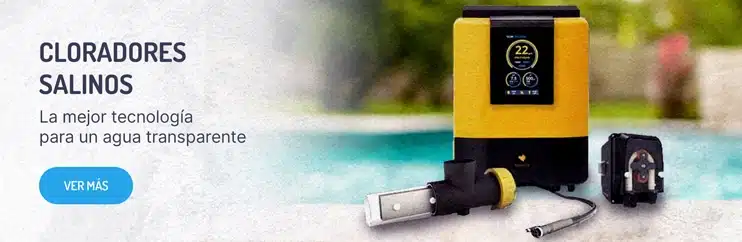
A modern salt chlorinator consists of three key elements:
When salt water passes through the cell:
The result is a continuous production of free chlorine, which maintains the pool at optimal levels (1-3 ppm) without the need to add external products on a regular basis.

Electrolysis performance depends on several parameters:
During electrolysis, gaseous hydrogen (H₂) is also generated in small quantities, which is safely evacuated through water circulation. In addition, today’s chlorinators include protection systems that stop production in case of:
This guarantees not only the safety of the equipment, but also an efficient use adapted to the real conditions of the pool.
How much salt does a salt chlorinator pool need?
The ideal concentration is usually between 4 and 6 grams of salt per liter of water.
How often should the electrodes be checked?
It is advisable to check them several times a year to ensure that they do not accumulate scale or dirt that reduces their performance.
Does a salt chlorinator completely replace chemical chlorine?
Yes, since the system itself produces the necessary chlorine. In specific cases, such as shock treatment, additional reinforcement may be necessary.
How to choose a Salt Chlorinator?
It depends on the volume of water in the pool and the needs of use. We have a step-by-step guide explaining which salt chlorinator to buy and how to install it correctly.
Do salt chlorinators require maintenance?
Yes, although it is minimal: salt level control, electrodes revision and pH adjustments. To do this you can follow our Salt Chlorinator maintenance guide.


PoolComet choice
 Select options
This product has multiple variants. The options may be chosen on the product page
Select options
This product has multiple variants. The options may be chosen on the product page

Tips to open your pool effectively: learn how to prepare your pool for summer with these simple steps.

Compliance with Royal Decree 487/2022 on Legionella. PoolComet News and Support. An Overview of the New RD Legionella.

Discover how to deep clean your removable pool. Learn how to keep the bottom, liner, waterline and filters clean, in addition to balancing the water. This expert guide provides you with the key steps and products for effective maintenance and prolonging the life of your installation.
Seleccionar categoria